
Interview with
SUKRITI PATNY
WINTER ISSUE #15 POET
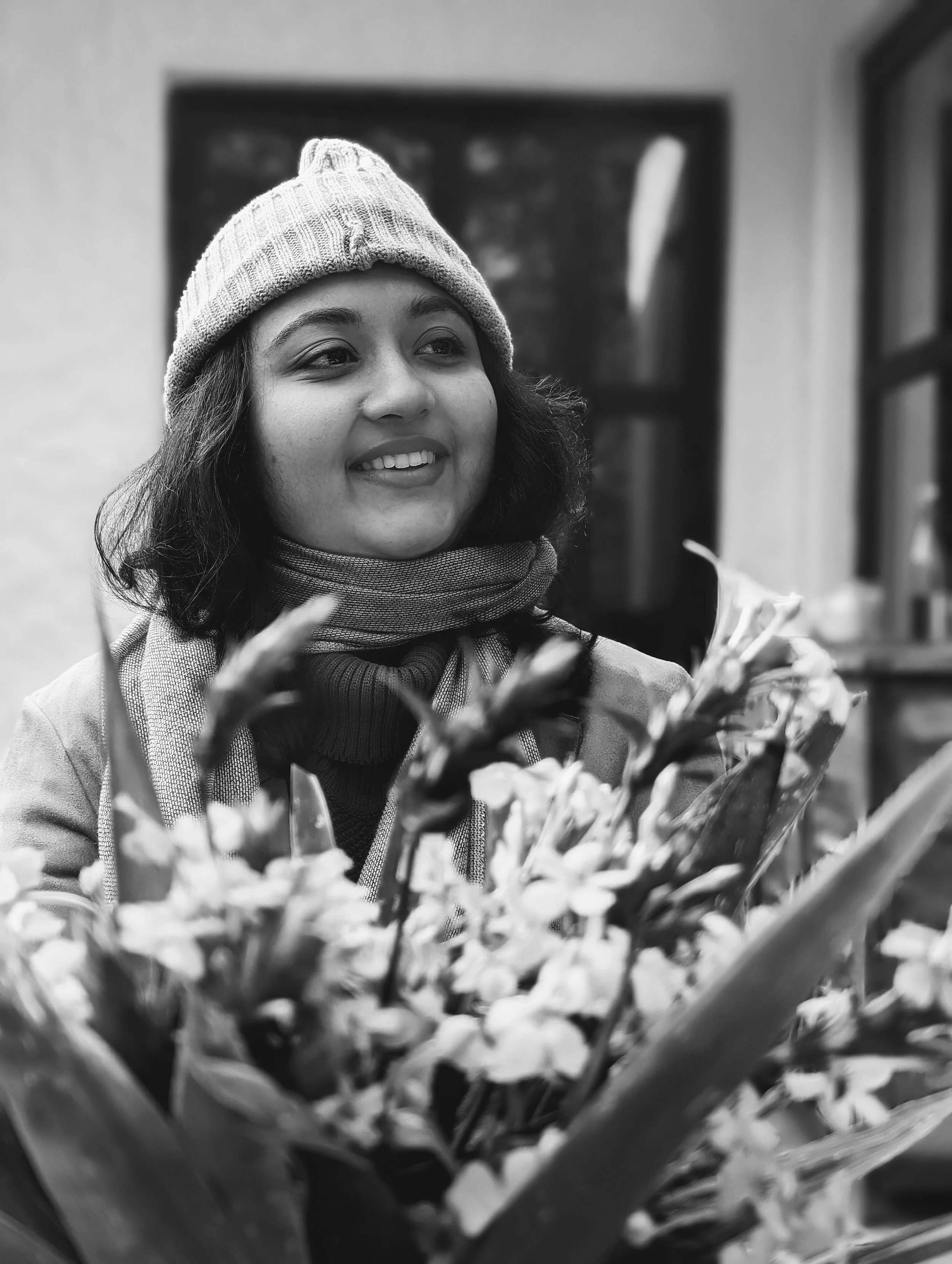
Sukriti Patny is a poet by dawn, and an overthinker by day. Her work explores the intersection of emotion and the body, presents everyday-ordinary things that leave her awestruck, and hopes to highlight the reverence that nature invokes in her. She currently lives in India with her husband and her anxiety.
Find Sukriti Patny’s
work on Instagram at
@wordsbysu and on Substack: sukritipatny.substack.com
HAIKU
swallowed by Saturn
a torn moon turns into sand
ice—pure alchemy
Tell us about your work.
In my writing, I like to use the outside world to understand what happens within the body, because I believe the patterns of the universe have always held the keys to unlocking what is inside us. Most of the natural world is already poetry! And through my work, I hope to infect others with the awe I hold for it.
What makes this piece important right now?
Sometimes when I look at the world all I see is destruction. But it is important to remember that all creation is born out of destruction. It is a constant cycle, and we must ask ourselves what we are creating, what we are turning into.
I wanted Saturn’s moon to be a reminder of what we can become when the worst happens. That we can still become something pure and distinct and gorgeous. This is a story of survival. A story of transformation.
What do you hope readers will take away from this piece?
Hope. There’s hope in every little and not-so-little thing around us. And if we can really look at things, we’ll find it.
How does your faith life/ethical outlook inform your writing?
My faith preaches that everything is divine. The grass you’re walking over, the tree outside your bedroom, the yellow potter wasp building a nest on your balcony, the otters that frolic on the riverbank, and the life inside every living thing—there is divinity in all of it.
A lot of my writing stems from a place of wanting to see or understand that better; to find the links between the outside world and the inside world.
Recognising and understanding how we, as human beings, are the same as every other thing that inhabits this universe is crucial to undoing our anthropocentrism.
What is the most difficult part of your artistic process?
Time. I think, often, I need to give my work enough time to marinate and bloom into something else. A first draft and a final draft could even be a year apart and that’s okay! Trying to rush through that process—the impatience and urge to want something finished, interferes with the ability of that piece to grow into something richer.
How do your interests feed into your writing practise?
At a time when attention spans are ever reducing, and the addiction to scrolling is hard to let go of, birdwatching has helped me hone both my observation skills and my patience. It has also taught me to be on the lookout for the little things that elicit emotion in everyday life.
As someone who practises yoga and breathwork, I also like to play with the breath in my poetry with the use of white space, a sense of breathlessness via prose poems or gasps via enjambed line-breaks.
How did your first publication change your process of writing?
For me, my first publication in some way reinforced my imposter syndrome and insecurities. I compared my work to everyone else’s in the same issue and found it lacking.
My yoga practise revolves around the concept of ahimsa—of non-violence, of being gentle. And I am trying to bring that off the mat and into my writing—being non-judgemental and gentle with my work, both in the initial stages of creating and reworking it, where the flaws are easy to focus on, and in the later stages of submission and publication, where comparisons can interfere with feeling joy or accomplishment.
If you could tell your younger writing self anything, what would it be?
For so long, I was hesitant to share my writing for fear of how it would be perceived by my friends and family. But I’ve found that vulnerability really sparks vulnerability.
Everyone is trying to make sense of this life. So, I’d tell my younger self to embrace these fears and insecurities and to shine a light on them. That can lead to the possibility of finding community.