
Interview with
ABBY HARDING
WINTER ISSUE #15 WRITER
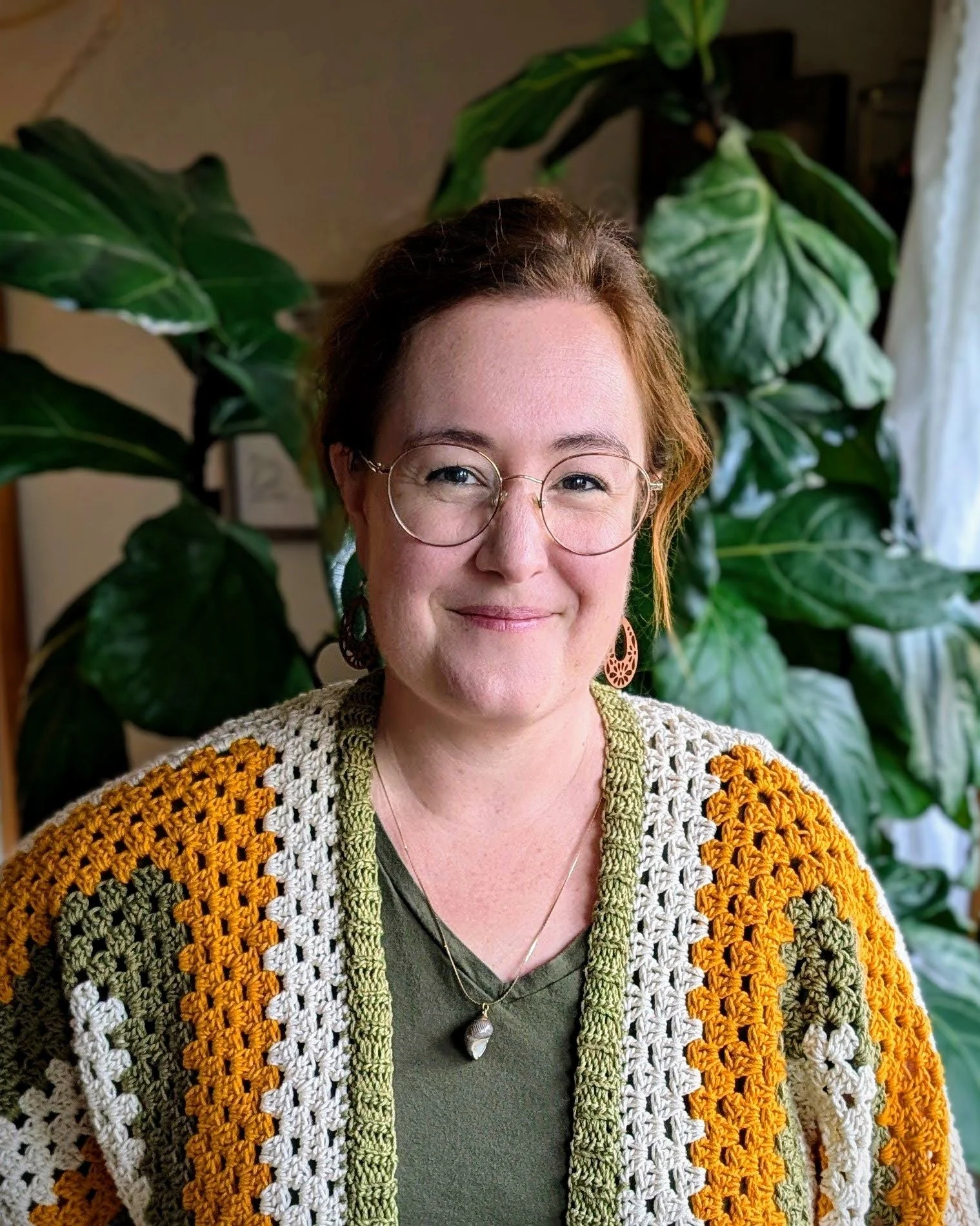
Abby Harding writes from her home in a small farm town in central Illinois. Her work draws on the natural world, focusing on the intersection of grief and hope. When she’s not writing or gazing into the middle distance, she and her husband homeschool their three children and care for a small menagerie of animals (six chickens, a guinea pig, and one geriatric cat). Her first poetry collection, Some Days Are Sandstone, debuted in October 2024, and a book of haiku is scheduled for publication in early 2026.
Learn more about
Abby Harding’s work at
abbyharding.com
TWO HAIKU
As dusk fades to gray,
a slim fingernail of moon
smiles up at Venus.
On seeing the winter moon:
Does she shine brighter
in the cold, or do I slow
down enough to see?
Tell us some more about your work.
The haiku included in this issue are part of a larger project. Late in 2024, I picked up a book of traditional Japanese haiku at the library. Each poem dripped with resonance—not just beautiful imagery, but deep meaning below the seemingly simple words. My blood pressure and heart rate decreased every time I opened the book, and I felt more grounded and calm when I set it down again.
I already knew that the primary job of a poet is to observe, to see the nuance and beauty in literally everything. I knew from experience that for me to write, I have to spend at least a little time slowing down to be present with the world around me. I still struggled to intentionally choose that most days, but I knew it was possible, and on those pages, I saw three writers from ancient Japan practice their presence relentlessly. I began to wonder if I could tap into the power-in-miniature of haiku, too.
Enter the 300 Haiku project, in which I committed to writing 300 haiku in 2025 (25 a month). I opted to stick with the western, 17-syllable haiku form (5-7-5), mostly because I love the challenge of strict constraint. I’ve stayed on track, and I’ll be finishing the project in December!
What has this project taught you?
So many things! For one, the compounding power of small acts of creation. A tiny poem on its own is lovely, but three hundred together is a book draft. Having this little moment of creativity almost every day has brought me a lot of joy this year and has boosted my confidence in my ability to see a project through to the end. It has also acted like a canary in the coalmine: if I can’t write a haiku, or it feels like pulling teeth, I’m over-tired or not present enough in my own life. It reminds me to slow down and ground myself in the here and now—a skill that feels increasingly important in an era that feels less and less stable “out there.”
What do you hope readers will take away from your work?
I understand now how the haiku masters brought such reverence and humor to their work: there is so much to love right where we are. The world is a huge, beautiful place, but we often miss the awe waiting for us right outside our own front doors. Having this project running in the back of my mind all the time made me pay attention in ways I hadn’t been. I notice more, I love more, and I share it more (just ask my family how often I gush over our backyard squirrels, for example). I hope that a small part of that seeps from my work into the reader’s life, leaving them feeling empowered to practice noticing and being present in their place and time, too.
Have you always written poetry, or do you write other forms, too?
I do write other forms and genres (creative nonfiction, short stories, and a smattering of mostly unfinished novel drafts), but poetry has always felt the most essential. I see myself and the world most clearly through poetry, which has an ability to capture the essence of a moment in a way prose sometimes can’t. There’s also an element of practicality in writing poetry in this season of my life. My husband and I are both in grad school and raising our children, and finding time to dedicate to long-form creative writing is often an exercise in frustration. That won’t be the case forever, but even when it’s not, I think poetry will still be home base.
Is writer’s block real?
Ha! Yes, I think writer’s block is real, but I think it’s a symptom of something deeper, not something that exists on its own. Most of the time, I think blocks are actually hidden exhaustion, disconnection, or fear. To get unblocked, we have to address those deeper issues first.
After the writing’s finished, how do you judge the quality of your work?
For me, there’s an emotional vibration that happens when a piece works. It’s an almost physical sensation—a fluttery, vulnerable feeling deep in my belly that’s both terrifying and deeply satisfying. When a piece works, I find myself nodding as I read it back: “Yes, that’s the truth.”
What’s next for you?
I have a secret goal of finishing the first draft of a middle grade novel I began in 2024 while my kids are still young enough to see themselves on the pages, but poetry will continue to be my main focus in 2026. The 300 Haiku project will come out in paperback in early spring, and I’ll be working on drafting my next full-length collection as well.